The Pop-Up Store as a Guerrilla Marketing Tool: Disruption by Design

Ghalia Boustani
PhD · Retail Expert & Author
Guerrilla marketing was born from a simple premise: that creativity, surprise, and precision targeting can outperform budget. The pop-up store, at its most powerful, operates on exactly the same logic, and in a media-saturated world, that logic has never been more relevant.
In 2025, I contributed a chapter to the Springer Nature volume Fashion Marketing: The Contemporary Marketing Mix, examining how pop-up stores function as a guerrilla marketing instrument for fashion brands. The research behind that chapter crystallised something I had been observing in the field for years, something that was intuitive to the best brand activators but rarely articulated with strategic clarity.
Pop-up stores and guerrilla marketing share a structural DNA. They are both built on the principle that impact does not require scale, that a precisely placed, brilliantly executed intervention in the right context can generate awareness, emotion, and behaviour change that dwarfs what a conventional campaign achieves at ten times the cost.
Understanding why this is true, and how to design for it deliberately, is the subject of this article.
"Guerrilla marketing taught us that the element of surprise is worth more than the size of your media buy. The pop-up store takes that lesson into three dimensions."
What Guerrilla Marketing Actually Is , and What It Isn't
The term 'guerrilla marketing' was coined by Jay Conrad Levinson in his 1984 book of the same name, borrowing the military metaphor of unconventional warfare: small, mobile, highly targeted operations that achieve outsized impact against a better-resourced opponent.
In its marketing application, guerrilla tactics are characterised by three qualities: unexpectedness (the encounter is not where the audience expects advertising to be), immediacy (the impact is direct, sensory, and present-tense rather than mediated), and conversation-worthiness (the encounter is designed to be shared, discussed, and retold).
What guerrilla marketing is not is cheap creativity for its own sake. The stunts that become cautionary tales, the activations that generated confusion, offence, or simply indifference, are typically those where the guerrilla logic was applied without strategic grounding. Surprise without relevance is just noise. Disruption without purpose is just chaos.
The best guerrilla marketing, like the best pop-up stores, earns its audience's attention by offering something genuinely worth their time: an experience, a moment of delight, a discovery that feels like a gift. The disruption is in service of the relationship, not a substitute for it.
The Five Guerrilla Principles , and How Pop-Ups Embody Each
Drawing on both guerrilla marketing theory and my own research into ephemeral retail, I identify five core principles that the most effective pop-up-as-guerrilla-tool activations share. These are not sequential steps, they are simultaneous qualities that must all be present for the approach to work.
01 Surprise Through Unexpectedness of Location
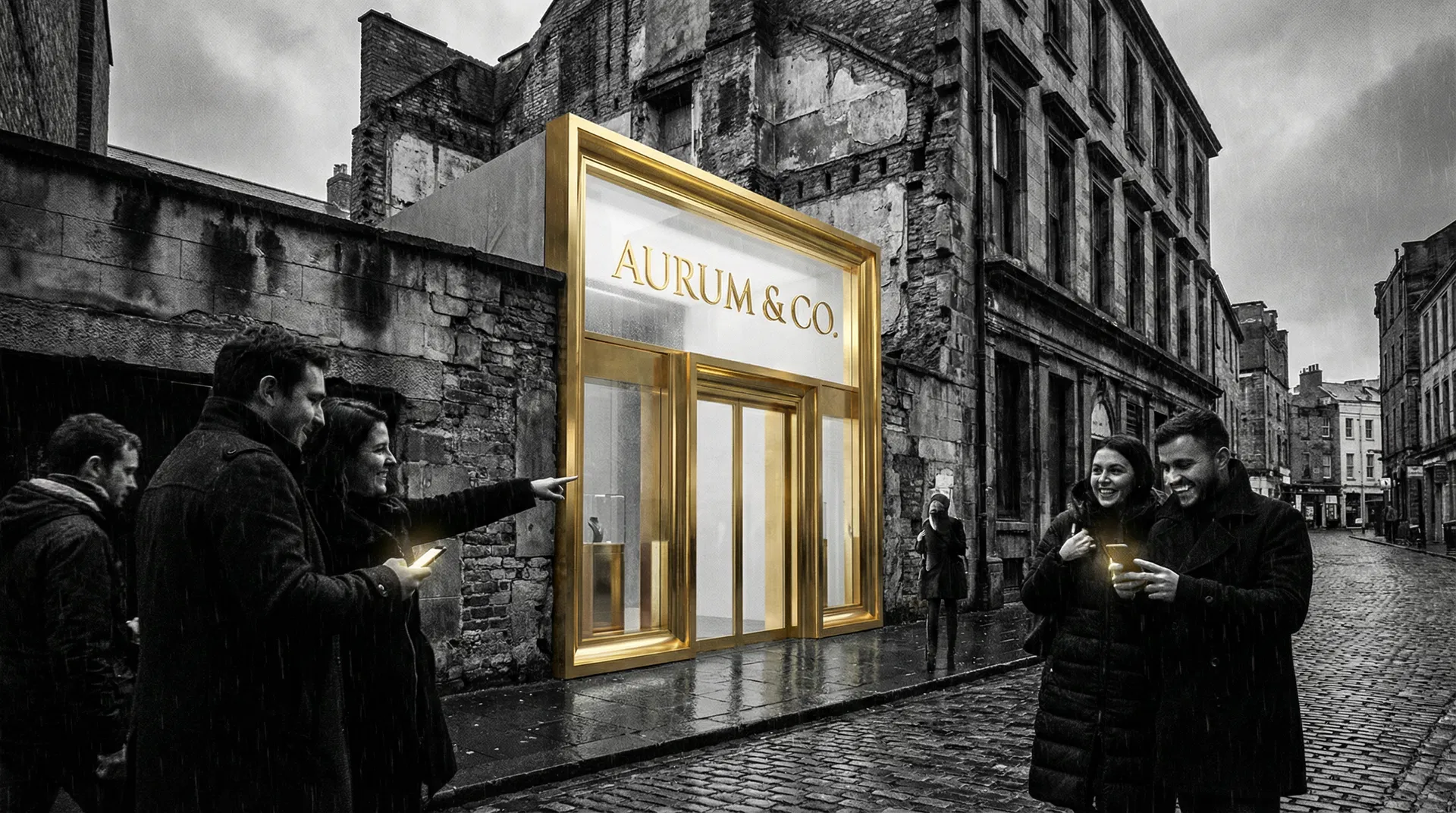
The guerrilla logic begins with placement. A pop-up in a predictable location, a prime high street, a premium shopping centre, a trade show floor, is not guerrilla retail. It is conventional retail with a shorter lease. The guerrilla pop-up appears where the audience does not expect to encounter the brand: a vacant lot in an emerging neighbourhood, the concourse of a train station, the forecourt of a museum, the courtyard of a cultural institution.
Location unexpectedness does several things simultaneously. It generates organic curiosity, people stop because something unusual is happening in a familiar space. It communicates brand personality, a brand confident enough to operate outside the conventional retail hierarchy is signalling something about its own confidence and cultural intelligence. And it reaches people in a mental state that is different from shopping mode: less transactional, more open, more receptive to an experience that surprises them.
02 Precision Targeting Over Broad Reach
Guerrilla marketing's power comes not from reaching everyone but from reaching exactly the right people in exactly the right context. A pop-up activation in a neighbourhood with a high concentration of the brand's target consumer, even if that neighbourhood generates a fraction of the footfall of a central shopping district, will outperform a central location in terms of meaningful engagement, conversion, and word-of-mouth generation.
This requires genuine knowledge of the target consumer: not just demographic data but behavioural and cultural intelligence. Where do they spend their Saturdays? What other brands and institutions do they trust? What cultural events draw them? The brand that can answer these questions can place its pop-up with the precision of a guerrilla operative, arriving exactly where its audience is, in a context that feels native rather than intrusive.
From the research: In my chapter in Fashion Marketing: The Contemporary Marketing Mix (Springer Nature, 2025), I examine how luxury fashion brands have used neighbourhood-specific pop-up placements to reach emerging consumer segments that their permanent flagship stores, by definition located in established luxury districts, were structurally unable to access. The guerrilla logic solved a distribution problem that conventional retail strategy could not.
03 Generating Conversation: Designing for Word-of-Mouth
The most powerful guerrilla activations are not experienced only by those who attend them. They are experienced by a much wider audience through the accounts of those who did. The design question is not merely 'what will visitors experience?' but 'what will visitors say to others after they leave, and what will they show them?'
This requires building conversation-worthy moments into the activation deliberately. Not as a cynical bid for social media content, though social amplification is a legitimate outcome, but as a genuine commitment to creating something that deserves to be talked about. The unexpected detail that rewards close attention. The interaction with staff that becomes a story. The product or gesture that visitors feel compelled to share because it reflects something true about who they are and what they value. These moments do not happen by accident. They are designed.
04 Time as a Strategic Resource: The Power of Scarcity
Conventional retail works against scarcity: the permanent store is always there, always stocked, always open. Guerrilla marketing works with scarcity: the limited edition, the one-night event, the activation that exists for a week and never returns. The pop-up store is the retail format that most naturally embodies this principle.
Temporal limitation creates genuine urgency, not the manufactured urgency of a countdown timer on an e-commerce page, but the real urgency of something that will genuinely cease to exist. Visitors who know they are in a space that will not be there next week experience it differently from visitors in a permanent store. They are more present, more engaged, more likely to act. The scarcity is not a constraint to apologise for. It is the activation's most powerful asset.
05 Asymmetric Return: Maximum Impact, Minimum Footprint
The guerrilla principle is fundamentally about resource efficiency: achieving disproportionate impact relative to investment. A well-designed pop-up store can generate brand awareness, media coverage, community building, product sales, and market intelligence, simultaneously, within a few weeks, from a space that costs a fraction of a permanent location's annual commitment.
This asymmetry is what makes the format particularly compelling for brands at growth stages where capital is constrained, for luxury brands wanting to protect the scarcity of their positioning, and for established brands wanting to reach new audiences without diluting their core brand identity. The temporary nature is not a compromise, it is the mechanism of the asymmetry.
"The best pop-up activations are not remembered as stores. They are remembered as moments. That is the guerrilla ambition , and the highest compliment retail can receive."
Where Guerrilla Pop-Ups Most Often Go Wrong
The guerrilla pop-up fails in predictable ways, and most of them trace back to a single error: treating the format as a spectacle rather than a relationship. The activation that is spectacular but hollow, visually impressive, socially amplified, strategically empty, generates a spike of attention that evaporates within days, leaving nothing behind but a depreciated content library.
The guerrilla logic requires that the disruption serve the relationship. The surprise must resolve into something meaningful for the person it surprises. The conversation-worthiness must come from genuine substance, not manufactured novelty. The scarcity must protect something valuable, not simply create the performance of exclusivity.
The other common failure is inconsistency between the guerrilla activation and the brand's broader behaviour. A brand that presents itself as brave and unconventional in a pop-up but operates conventionally across every other touchpoint creates cognitive dissonance in its audience. The guerrilla pop-up is most effective when it is an expression of a brand character that is genuinely present everywhere, not a mask worn for the occasion.
The Practical Implications for Brand Teams
For brand managers and marketing teams, the guerrilla pop-up framework offers a useful reorientation of how activations are briefed and evaluated. Instead of beginning with the question 'what space should we take and how should we dress it?', which is a production question, the brief should begin with guerrilla questions.
Where would our target consumer be genuinely surprised to encounter us, and what would that surprise communicate about who we are? What is the one moment, the one interaction, the one detail in this activation that will make someone tell a friend? What is the constraint, the budget limit, the timeline, the location restriction, that we can turn into a creative advantage rather than a compromise?
These questions do not require a large budget to answer well. They require a clear understanding of the brand, a genuine knowledge of the target consumer, and the creative discipline to achieve more with less. Which is, of course, exactly what guerrilla marketing has always demanded, and exactly what the best ephemeral retail has always delivered.
What is the most disruptive, unexpected pop-up or brand activation you have ever encountered, as a consumer, a practitioner, or an observer? What made it land? I am always curious about the moments that genuinely surprised people.
This article draws on research published in: Integrating Pop-Up Stores in Fashion Brand Strategies: A Guerilla Marketing Approach , in Fashion Marketing: The Contemporary Marketing Mix, eds. Laura Costin & Liz Barnes. Springer Nature, 2025.
FURTHER READING
Explore Ghalia Boustani's Books on Retail & Pop-Up Stores
From ephemeral retail strategy to guerrilla brand activation and fashion retail survival, four books that go deeper into every idea explored in this article.
Ephemeral Retailing: Pop-Up Stores in a Postmodern Consumption Era · 2019
Pop-Up Retail: The Evolution, Application and Future of Ephemeral Stores · 2021
A Fashion Retailer's Guide to Thriving in Turbulent Times · 2022
Understanding Pop-Up Stores through Passion and Practice · 2025
All published by Routledge. Browse and order at routledge.com/search?author=Ghalia%20Boustani
— WORK WITH GHALIA
Ready to transform your retail strategy?
Book a consultation to discuss your retail challenges and how Ghalia's expertise can help.
BOOK A CALL