Retail Atmospherics: Why the Store Environment Is Your Most Powerful Salesperson

Ghalia Boustani
PhD · Retail Expert & Author
Before a single word is spoken, before a product is touched, before a price tag is read, the environment has already done most of its work. Retail atmospherics is the science and art of that invisible influence. And most brands are barely scratching its surface.
There is a moment, familiar to anyone who has walked into a beautifully designed store, when the decision to stay, to slow down, to look more carefully, to feel something, is made before you are even consciously aware of it. Something in the air, literally and figuratively, has shifted your state. You are no longer a passerby. You are a guest.
That moment is not accidental. It is designed. And the discipline behind it, retail atmospherics, is one of the most powerful and most underutilised tools available to anyone who operates a physical commercial space.
The concept was first formalised by the marketing scholar Philip Kotler in 1973, who argued that the atmosphere of a retail space could be a more influential purchase trigger than the product itself. Half a century of subsequent research, including foundational work by Turley and Milliman, and a generation of studies in consumer neuroscience, has confirmed and refined that argument. The environment does not merely accompany the shopping experience. In many cases, it is the shopping experience.
"The atmosphere of a space is not decoration. It is the first, most pervasive, and most persuasive communication a brand makes."
What Atmospherics Actually Means
Atmospherics refers to the deliberate design of the sensory and spatial qualities of a retail environment in order to produce specific emotional and behavioural responses in the people who enter it. It encompasses everything that a visitor perceives, consciously and unconsciously, from the moment they approach the exterior of a space to the moment they leave.
This includes the obvious: visual design, colour palette, lighting, spatial layout, product display. But it also includes the less obviously commercial: scent, sound, temperature, the texture of surfaces, the height of ceilings, the behaviour and appearance of staff, the pace at which the space unfolds as you move through it.
Each of these elements communicates something. Each of them influences how long a visitor stays, how they feel while they are there, how they perceive the products on offer, and, critically, whether they return. The brands that understand this design each element intentionally. The brands that do not leave those communications to chance. And chance, in retail, is rarely kind.
The Five Sensory Dimensions , and What the Research Tells Us
Atmospheric design operates across all five senses, though retail has historically over-indexed on vision at the expense of the others. Here is what decades of consumer research tell us about each dimension, and what it means in practice.
👁 Sight , The Dominant Channel, and the Most Misused
Visual design is where most retail investment goes, and where most of the clichés live: the minimalist luxury aesthetic, the maximalist independent boutique, the corporate sameness of chain retail. But the research on visual atmospherics is more nuanced than most retail design suggests.
Colour temperature affects perceived product quality: warmer tones create intimacy and slow movement; cooler tones signal precision and efficiency. Lighting directionality shapes how products are perceived, diffuse light creates comfort, focused spotlighting creates drama and draws the eye. Ceiling height influences abstract versus concrete thinking: higher ceilings encourage exploration and creativity; lower ceilings focus attention on specific products. And spatial density, how much product is displayed, how much floor is visible, how much breathing room exists between fixtures, communicates brand positioning as powerfully as any logo.
✦ Scent , The Most Underestimated Tool in Retail
Of all the atmospheric dimensions, scent has the most direct neurological pathway to memory and emotion. The olfactory system connects more immediately to the brain's limbic system, the seat of emotional processing, than any other sense. This is why a smell can retrieve a memory with more vividness and immediacy than a photograph.
For retail, this has significant implications. A distinctive ambient scent, one that is ownable, consistent, and aligned with the brand's emotional positioning, creates a sensory anchor that deepens brand memory and extends the duration of store visits. Research consistently shows that pleasant ambient scent increases time spent in a space, perceived product quality, and purchase intention. The brands that have understood this, from luxury fashion houses to independent bookshops, treat scent as a core brand asset, not an afterthought.
Research note: Studies by Spence and Piqueras-Fiszman (2014) on crossmodal correspondences show that scent does not operate in isolation, it interacts with music, lighting, and spatial design to create a composite sensory experience. Dissonance between these elements produces subconscious discomfort; coherence produces the feeling of a brand that knows exactly who it is.
♪ Sound , Pace, Volume, and the Invisible Conductor
Music in retail is often treated as background, a practical necessity to fill silence. The research suggests it is anything but. Music tempo directly influences the pace at which customers move through a space: slower tempos increase dwell time and, in appropriate contexts, purchase value. Volume affects density tolerance: louder music works in spaces designed for energy and youth; quieter music signals premium positioning and encourages deliberate browsing.
Genre and cultural association matter too. Music communicates brand identity in ways that are felt before they are consciously registered. A brand that plays carefully curated, unexpected music signals taste and curation. A brand that plays the same commercial playlist as every other retailer on the street signals indifference. The soundtrack of a space is a brand statement. It should be treated as one.
◇ Touch , The Underdesigned Dimension
Physical texture is among the most emotionally resonant of the sensory dimensions, and among the least deliberately designed. The materials used in fixtures, flooring, and display surfaces communicate quality, warmth, and brand character in ways that bypass conscious evaluation. Rough-hewn wood signals craft and authenticity. Polished metal signals precision and luxury. Soft furnishings signal intimacy and ease.
Product accessibility is equally important. Research on haptic engagement, the psychology of touch in shopping, consistently shows that physical contact with a product increases perceived ownership and purchase likelihood. Retail spaces that encourage touching, handling, and trying, rather than encasing products behind glass or placing them out of reach, are spaces that convert browsers into buyers.
◌ Temperature and Air Quality , The Invisible Comfort Layer
Temperature is rarely discussed in retail design briefs, but it operates continuously on visitor comfort and behaviour. A space that is too warm induces lethargy and shortens visits. A space that is too cool creates discomfort and urgency to leave. The ideal temperature for a retail environment varies by season, by brand positioning, and by the physical activity level of the experience, but it should always be deliberately calibrated, not left to the default setting of an HVAC system.
Air quality and freshness interact with scent design: a space that smells pleasant but feels stuffy creates cognitive dissonance. The base condition must be right before the designed elements can do their work.
The Coherence Principle , Why Everything Must Work Together
The most important insight from atmospheric research is not about any individual sensory dimension. It is about the relationship between them. Coherence, the degree to which all sensory elements tell the same story, is the single most important quality of effective atmospheric design.
A space with beautiful visual design but an incongruous soundtrack creates subconscious dissonance. A space with an exquisite ambient scent and harsh fluorescent lighting produces confusion. A space where the product display suggests luxury but the flooring suggests a supermarket undermines both messages simultaneously.
Coherence requires a clear brief: what emotional state should this environment create? What brand character should every element reinforce? When the answer to these questions is crisp and shared across every design decision, from the choice of floor material to the briefing of the cleaning staff on the scent of the products they use, the result is a space that feels inevitable. Visitors cannot always say why they feel so comfortable, so stimulated, so drawn to stay. They just do.
"Coherence is the difference between a space that has been decorated and a space that has been designed. Visitors feel it immediately, even when they cannot name it."
Atmospherics in Pop-Up Stores , A Unique Opportunity
Pop-up stores offer a particular opportunity for atmospheric design that permanent retail rarely matches. Because they are temporary, they can be designed from scratch around a single atmospheric brief, without the accumulated compromises of a permanent space: the structural column that interrupts the layout, the inherited flooring that clashes with the new brand direction, the lighting system that cannot be modified.
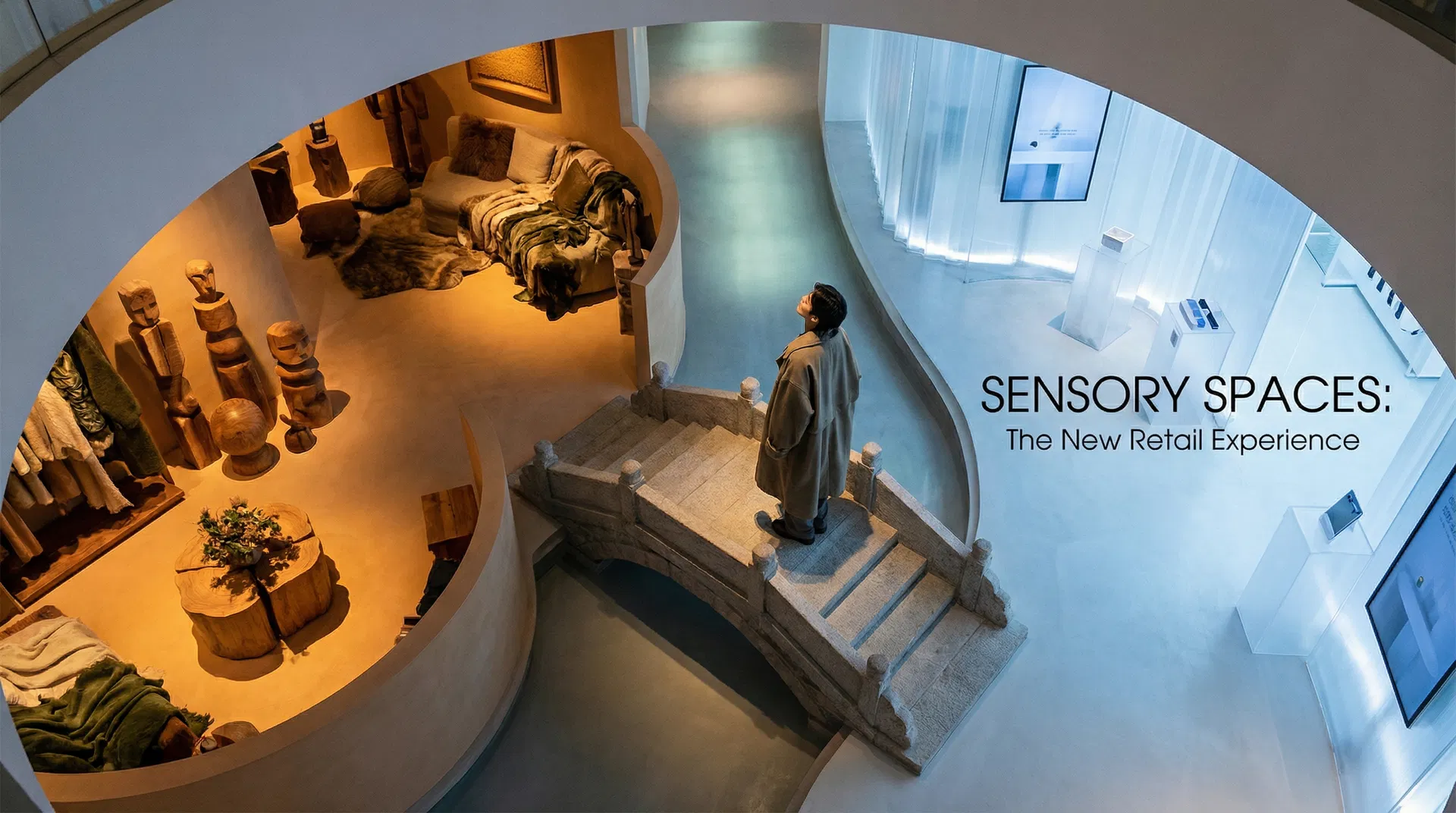
In a pop-up, everything is a choice. The designer approaches an empty space, often a raw, industrial, or unconventional one, and builds a complete sensory world. This is both the challenge and the gift of ephemeral retail design. The absence of defaults forces intentionality. And intentionality, applied with skill and a clear brief, produces the most memorable retail experiences available.
In my research across more than 90 pop-up case studies, the activations that generated the strongest brand impact, measured in recall, sentiment, and post-visit brand preference, were almost invariably those where atmospheric design had been treated as a strategic priority rather than a finishing touch. The environment was not the backdrop to the experience. It was the experience.
What This Means for Practitioners
If you are responsible for a physical retail space, whether permanent or ephemeral, the practical implication of atmospheric research is this: every sensory element of your environment is communicating something, whether or not you have designed it to. The question is not whether to do atmospheric design. It is whether to do it consciously or by default.
Start with a single question: what should a visitor feel in this space? Not think, not do, feel. Surprised? Calm? Energised? Exclusive? Curious? The emotional outcome you are designing for should precede every material decision, every playlist choice, every fixture selection.
Then audit your current environment against that brief. Walk in as a stranger. What does the scent tell you about the brand? What does the music say? What does the temperature and air quality communicate? What do the materials of the surfaces signal? How does the lighting frame the products? How does the spatial layout guide movement and attention?
Most brands, when they do this honestly, find significant gaps between the experience they intend and the experience they deliver. Closing those gaps does not always require significant investment. It requires attention, the specific, disciplined, sensory attention that great retail design has always demanded, and that the best environments have always rewarded.
What is the most atmospherically powerful retail space you have ever walked into, and what was it about the environment, specifically, that made it feel that way? I am always collecting examples of this done at its best.
FURTHER READING
Explore Ghalia Boustani's Books on Retail & Pop-Up Stores
Atmospherics, consumer behaviour, ephemeral retail, and the future of physical stores, explored in depth across four books published by Routledge.
Ephemeral Retailing: Pop-Up Stores in a Postmodern Consumption Era
Pop-Up Retail: The Evolution, Application and Future of Ephemeral Stores
A Fashion Retailer's Guide to Thriving in Turbulent Times
Understanding Pop-Up Stores through Passion and Practice
Browse and order at routledge.com/search?author=Ghalia%20Boustani
— WORK WITH GHALIA
Ready to transform your retail strategy?
Book a consultation to discuss your retail challenges and how Ghalia's expertise can help.
BOOK A CALL