The Rise of the 'Third Place' Pop-Up: When Retail Becomes Community

Ghalia Boustani
PhD · Retail Expert & Author
The most interesting retail spaces being created today are not stores. They are not cafés or galleries or community centres either, though they contain elements of all of these. They are something new: ephemeral gathering places that use commerce as the occasion for connection. Understanding why this is happening, and what it means for retail strategy, is one of the most important conversations in the industry right now.
In 1989, the sociologist Ray Oldenburg published a book called The Great Good Place, in which he argued that healthy communities require three kinds of spaces: the first place (home), the second place (work), and the third place, the informal gathering ground that is neither one nor the other, where people come not because they must but because they want to, and where the accidental encounter with others like themselves produces the social fabric of a neighbourhood.
Oldenburg was thinking of coffee houses, barbershops, bookstores, and public squares. He was not thinking about retail. But the concept he articulated has become, thirty-five years later, one of the most generative frameworks for understanding what the most compelling physical brand spaces are trying to become.
The 'third place' pop-up is a format that has emerged at the intersection of retail, hospitality, and community building. It is a space that uses the occasion of commerce, the product, the brand, the transaction, as the architecture around which a social experience is built. The purchase, if it happens at all, is almost incidental. What matters is what happens in the space between arrival and departure: the conversations, the encounters, the feeling of having been somewhere that existed for reasons more interesting than selling things.
"The most compelling retail spaces of the next decade will not be remembered for what they sold. They will be remembered for how they made people feel about being together."
Why This Is Happening Now
The emergence of the third place pop-up is not a coincidence. It is the convergence of several cultural and commercial forces that have been building for years and that the disruptions of the past decade have accelerated into urgency.
The first force is the loneliness problem. Across developed economies, social researchers have documented a sustained rise in reported loneliness and social disconnection, particularly among younger adults who are, paradoxically, more digitally connected than any previous generation. The appetite for spaces where genuine, unmediated human encounter is possible has never been greater. Brands that can create those spaces, that can be the occasion for connection rather than merely the context for consumption, are tapping into something that goes well beyond retail strategy.
The second force is the saturation of digital experience. The promise of the early internet, that digital connection would enrich social life, has given way to a more complicated reality. Consumers who spend the majority of their waking hours mediated by screens arrive at physical spaces with a heightened appetite for the tactile, the spontaneous, and the genuinely present. A physical gathering that offers the kind of unscripted human encounter that digital platforms systematically suppress is, in this context, genuinely rare and genuinely valuable.
The third force is the evolution of brand loyalty. The conventional loyalty model, points, rewards, transactional incentives, is losing its grip on the consumers brands most want to reach. The loyalty that endures is community loyalty: the feeling that a brand is not just a product provider but a shared identity, a set of values, a group of people you want to be associated with. The third place pop-up is, among other things, the most effective community-building tool available to a brand that wants to generate this deeper form of allegiance.
Five Manifestations of the Third Place Pop-Up
The third place pop-up takes many forms. What unifies them is the primacy of the social and experiential over the commercial, the understanding that the space's value lies in what it enables between people, not merely between people and products. Here are the five manifestations I observe most frequently, and what distinguishes each.
01 The Brand Residency
The brand residency is an extended pop-up, typically several weeks to several months, in which a brand establishes a temporary home in a neighbourhood, a cultural institution, or a hybrid space. Unlike a conventional pop-up, the residency is designed around programming as much as product: talks, workshops, screenings, collaborative events with local artists and makers. The product is present, but it is framed as one element of a broader cultural offer.
The residency works because it gives the brand time to become genuinely embedded in a community rather than simply visiting it. Regulars return not just for new product arrivals but for the next event, the next conversation, the next unexpected encounter. The temporal limitation, the knowledge that the residency will end, creates the same urgency that all ephemeral formats deploy, but in a social register rather than a purely commercial one.
02 The Concept Store as Living Room
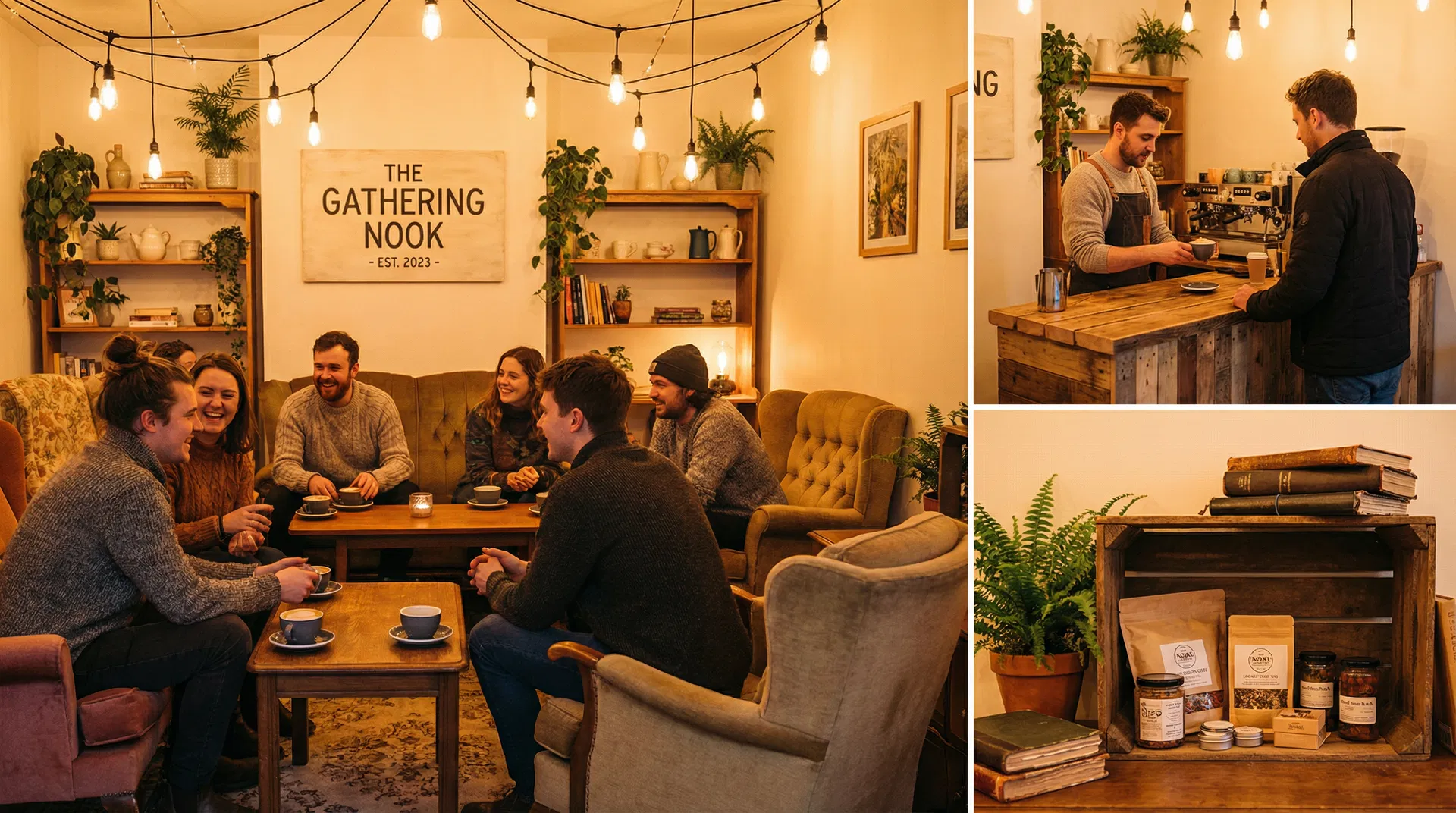
Several of the most talked-about retail concepts of the past decade share a spatial logic that prioritises comfort, lingering, and encounter over product display and transactional efficiency. Seating areas that invite genuine conversation. Communal tables where strangers share a coffee and, occasionally, discover a shared taste or a new recommendation. Staff whose role is closer to host than sales associate, present, knowledgeable, genuinely interested rather than transactionally motivated.
This is the third place logic applied to a fixed retail format: the store reimagined not as a place you visit to buy something but as a place you visit to be somewhere good. The products are curated with the same intentionality as the spatial design, selected not for commercial breadth but for the coherence of the world they create together. The consumer who discovers this kind of space does not simply become a customer. They become a habitué.
Observed in practice: In my research into pop-up formats across multiple geographies, I have observed that the spaces which generate the strongest community attachment, measured in repeat visits, unprompted advocacy, and the depth of the relationships formed, are almost invariably those where the social experience was designed with the same rigour as the commercial one. The coffee served matters. The music matters. Whether there are enough chairs matters. These are not peripheral concerns. They are the architecture of belonging.
03 The Collaborative Activation
The collaborative activation brings together multiple brands, makers, or cultural figures in a shared temporary space, each contributing their perspective, their product, or their community, and all benefiting from the combined cultural weight of the assembly. The logic is curatorial: the activation is interesting not because of any single participant but because of the intelligence of the combination.
For brands, the collaborative activation solves a specific problem: how to reach an audience that might not seek you out individually, by placing yourself in a context that attracts them for other reasons. For consumers, it offers the discovery experience that the best markets, fairs, and cultural events have always provided, the unexpected find, the conversation across stalls, the pleasure of a space where every element seems to have been chosen by someone with genuine taste.
04 The Learning Space
A growing number of brands are using their temporary spaces primarily as places of learning, workshops, masterclasses, talks, and hands-on experiences centred on the craft, the culture, or the values associated with the brand. The product may be sold, but the primary offer is knowledge and skill: the chance to understand how something is made, to learn a technique, to encounter the human beings behind the objects.
The learning space is particularly powerful for brands whose value proposition is rooted in craft or cultural authority. When a consumer makes something with their own hands using the brand's materials, or hears a maker explain the decisions behind a product, the relationship formed is categorically different from the one formed through conventional retail. It is a relationship built on understanding rather than aspiration, and understanding, as any retailer who has experienced it knows, produces a loyalty that aspiration alone never can.
05 The Neighbourhood Anchor
Perhaps the most ambitious expression of the third place pop-up is the activation designed to function as a temporary anchor for a specific neighbourhood or community, a space that fills a social function that the area lacks, and that the brand occupies for a defined period before passing it on or moving on. A brand that opens a free reading room in a neighbourhood with no public library. A fashion house that activates an empty shopfront as a community gallery for local artists. A food brand that creates a shared kitchen and dining space in a district underserved by affordable hospitality.
These activations generate a quality of goodwill and community relationship that is genuinely impossible to manufacture through conventional marketing. They require the brand to subordinate its commercial logic to a social one, to be willing to create real value for a community without a direct transactional return. The brands that do this with authenticity and consistency find that the indirect returns, in brand affinity, in cultural credibility, in the quality of the human relationships that result, are among the most durable they have ever generated.
"A brand that becomes a third place , even temporarily , is no longer just a brand. It becomes part of the infrastructure of someone's social life. That is a relationship no advertisement can build."
The Design Principles That Make It Work
The third place pop-up is not simply a conventional pop-up with a coffee machine added. It requires a fundamental reorientation of design priorities, from the commercial to the social, from the transactional to the relational, from the efficient to the generous.
Generosity is perhaps the most important principle. The third place gives more than it takes. It offers something, a space, an experience, a programme, a perspective, that has value independent of whether the visitor makes a purchase. This requires a brand confident enough in its long-term relationship logic to invest in encounters that do not immediately convert. That confidence is not naive; it is grounded in a sophisticated understanding of how lasting brand relationships are actually built.
Editorialisation is the second principle. A third place pop-up is curated, not comprehensive. Every element, the products stocked, the events programmed, the collaborators invited, the books on the shelf, the music playing, reflects a point of view. The space communicates who it is for and what it believes in, and it does so with enough specificity that the right visitor feels immediately at home, and the wrong visitor knows, equally immediately, that this is not their space. This is not exclusion, it is the honest expression of identity that all genuine communities require.
Staffing, as in every pop-up format, is the third and most human principle. The people who inhabit a third place pop-up must be people who genuinely want to be there, who are curious about the visitors, interested in the conversations, invested in the community being created. A third place staffed by people performing hospitality is not a third place at all. It is a stage set. The difference is felt immediately, and it is the difference between a space that generates community and one that merely simulates it.
What This Means for the Future of Retail
The third place pop-up represents something significant in the longer arc of retail's evolution: the acknowledgment that physical commercial space has a social function that is not reducible to its commercial one, and that brands which understand and honour that function will build relationships with consumers that brands focused purely on transaction will never reach.
This is not a niche insight. The evidence is accumulating across categories, geographies, and brand scales that the physical spaces generating the strongest long-term brand equity are those that people visit not because they need to but because they want to, because something social, cultural, or simply human draws them back.
In the context of ephemeral retail specifically, the third place logic amplifies the format's inherent strengths: the urgency of temporariness, the intensity of the bounded experience, the freedom from operational compromise. A pop-up that creates genuine community, even briefly, leaves something behind that no amount of advertising can replicate. It leaves a memory of having belonged, and the desire to belong again.
That desire is, ultimately, what all retail is trying to create. The brands that learn to do it through place and community rather than through product and promotion alone are the ones that will define what physical retail means in the decades ahead.
Have you experienced a retail space that genuinely functioned as a third place, somewhere you returned to not just to buy but to be? What made it feel like that? I am always looking for the examples that prove what is possible.
FURTHER READING
Explore Ghalia Boustani's Books on Retail & Pop-Up Stores
Community, consumer experience, ephemeral formats, and the future of physical stores, explored across four books published by Routledge.
Ephemeral Retailing: Pop-Up Stores in a Postmodern Consumption Era · 2019
Pop-Up Retail: The Evolution, Application and Future of Ephemeral Stores · 2021
A Fashion Retailer's Guide to Thriving in Turbulent Times · 2022
Understanding Pop-Up Stores through Passion and Practice · 2025
All published by Routledge. Browse and order at routledge.com/search?author=Ghalia%20Boustani
— WORK WITH GHALIA
Ready to transform your retail strategy?
Book a consultation to discuss your retail challenges and how Ghalia's expertise can help.
BOOK A CALL